

Real-Time Drinking Water Monitoring: The Lesson Mexico Can No Longer Postpone
The water quality crisis in the Guadalajara Metropolitan Area shows why utilities need continuous monitoring of residual chlorine and physicochemical parameters across the network — not occasional sampling
Throughout 2026, the Guadalajara Metropolitan Area — home to more than 4 million people — has become the most visible case of a reality affecting many Mexican cities: water can leave the treatment plant in compliance with the standard and still reach the home with no quality guarantees.
Citizen reports of turbid water with foul odors and abnormal coloration have multiplied across hundreds of neighborhoods in Guadalajara, Zapopan, Tlaquepaque, and Tonalá. Independent monitoring campaigns conducted by academics and civil organizations between March and July 2026 produced alarming findings:
- More than 90% of the samples analyzed lacked adequate residual chlorine levels, nullifying the basic disinfection barrier required by regulation.
- Turbidity levels of up to 40 NTU were detected, far above the regulatory limit.
- Laboratory analyses identified the presence of metals, nitrates, and microbiological contamination at various points in the network.
Health authorities went as far as recommending that residents not use tap water for drinking or preparing food, and the crisis led to protests, leadership changes at the water utility, and announcements of multibillion-peso infrastructure investments.
The problem is not exclusive to Guadalajara
Although the Guadalajara metro area holds the spotlight today, the pattern repeats at a national scale. Recent studies and reports converge on the same diagnosis: water tends to degrade on the journey between the plant and the home, due to aging networks, leaks that allow infiltration, deficient pressures, and poorly maintained household storage. It is estimated that around 40% of Mexico's treated drinking water is lost to leaks before reaching the end user — and every leak is also a potential entry point for contaminants.
The result is a crisis of trust with a real cost: Mexico is the world's largest consumer of bottled water, an expense that falls directly on families.
Regulation requires vigilance — technology makes it possible in real time
Mexico's regulatory framework is clear. NOM-127-SSA1-2021 establishes the permissible quality limits for water intended for human use and consumption; NOM-179-SSA1-2020 requires water supply systems to control the quality of distributed water, with free residual chlorine as the central surveillance parameter.
The challenge is operational: a utility serving millions of residents cannot monitor its network with manual sampling crews that visit each point only a few times per month. Between one visit and the next, a chlorination failure, an infiltration, or a turbidity event can go undetected for days — exactly what the citizen monitoring campaigns in Guadalajara exposed.
The alternative exists and is proven: online, continuous, automatic monitoring at the network's critical points.
What a 24/7 monitored network looks like
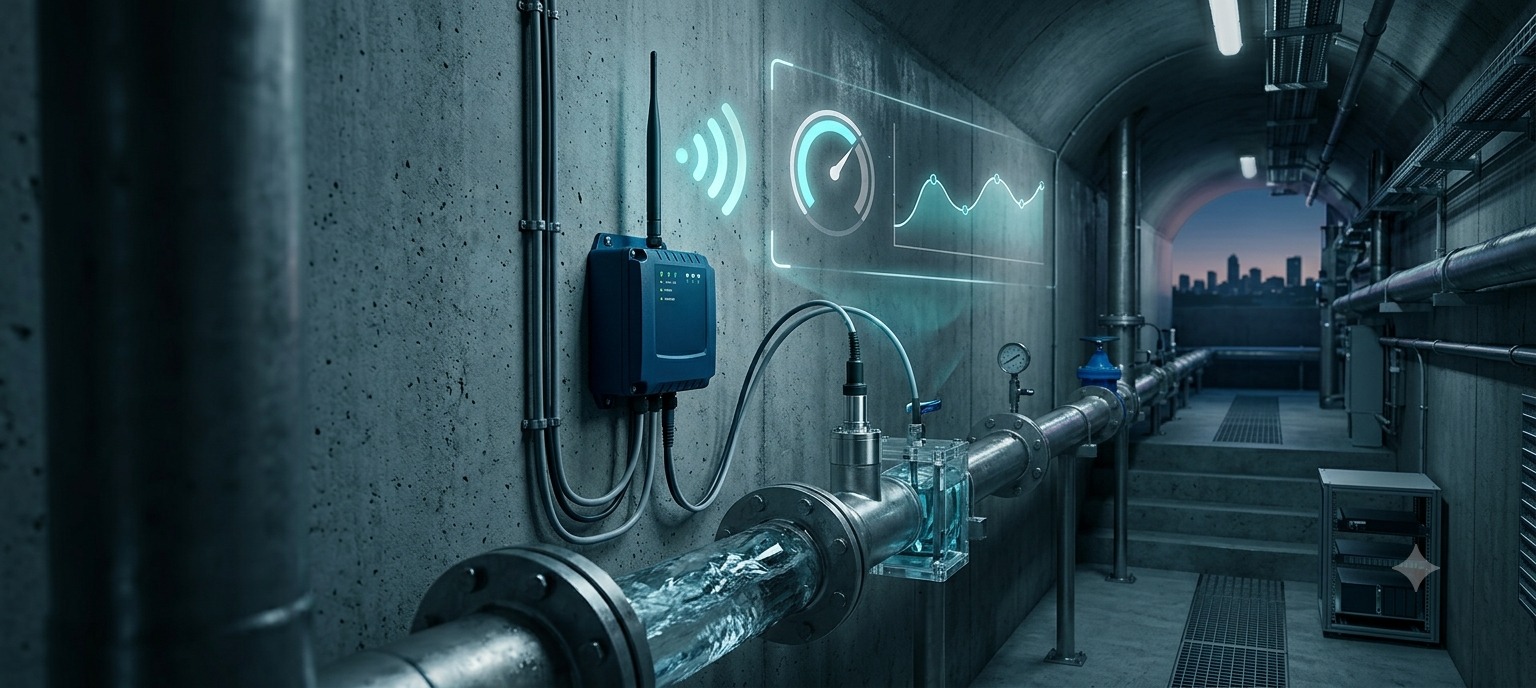
A modern drinking water monitoring scheme combines autonomous equipment installed directly in the distribution network:
Residual chlorine at network extremities — SOFREL Aquasector-CL. Network endpoints and low-circulation zones are where chlorine depletes first. This autonomous solution (datalogger + chlorine probe + mounting kit) measures free chlorine with 0.01 ppm resolution and generates automatic alarms the moment the disinfectant falls below the setpoint — precisely the early warning that was missing in the documented cases.
Multi-parameter monitoring at stations and chambers — MetriNet. Modular nodes (M-Nodes) that measure chlorine, pH, turbidity, temperature, and conductivity in a scalable way: parameters are added as the utility's needs grow, without replacing the installation.
Quality + pressure + flow at a single point — Smart Valve NeoFlow IPS/IPXS. Smart valves integrate pressure control with water quality and flow measurement, uniting two mutually reinforcing strategies: less excess pressure means fewer leaks, and fewer leaks mean fewer infiltration points.
IoT transmission and SCADA integration. All the data travels via NB-IoT, LTE-M, or GPRS to the utility's central platform, where it is visualized in real time, automatic alarms are generated, and regulatory compliance is documented with continuous data — not with isolated sampling reports.
From reaction to prevention
The difference between a utility that monitors online and one that doesn't is measured in response time: detecting a chlorine drop in minutes instead of discovering it weeks later through citizen complaints; pinpointing the affected sector precisely instead of searching blindly; demonstrating quality recovery with data instead of asking for trust.
Mexico's network infrastructure will take years to renew. The ability to know, at all times, what water is reaching people can be deployed in weeks.
At Marfel Ambiente, Agua y Energía we help water utilities design their monitoring network: critical point selection, equipment, communications, SCADA integration, and commissioning. Write to us at sales@marfelusa.com or explore the complete solution at Drinking Water Monitoring.